Why You Should Skip Wi-Fi Extenders and Choose a Mesh System Instead

If your router fails to provide a strong Wi-Fi signal throughout your home, the obvious solution might seem to be a Wi-Fi extender to boost the signal into those hard-to-reach areas. However, this common fix is actually a mistake you should avoid. Expert tests reveal that Wi-Fi extenders lead to slower speeds, increased latency, and greater congestion on your home network. With the availability of reliable Wi-Fi mesh systems that perform much better, extenders have become largely unnecessary.
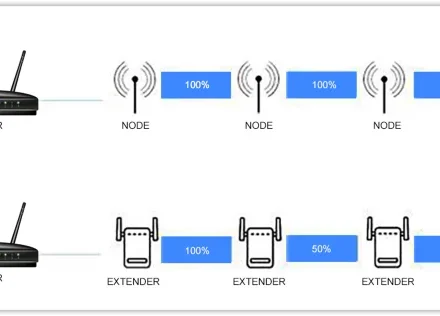
That said, there are still a few specific scenarios where an extender can help. Extenders capture your router’s signal and rebroadcast it, allowing you to connect from a bit farther away. Both experts and manufacturers agree that this makes them useful for eliminating narrow, isolated dead zones. The catch lies in their four-step process: they receive data from the router, transmit it to your device, receive a response from that device, and finally send the information back to the router. This double handling effectively cuts your bandwidth in half. At the same time, the rebroadcasted frequency adds interference to your entire network.
Why Mesh Systems Outperform Extenders
A Wi-Fi extender can technically increase the reach of your signal, but the resulting signal is often too weak to be practical. In contrast, a Wi-Fi mesh system is one of the best ways to boost both internet speeds and coverage area. Mesh Wi-Fi uses multiple nodes to create a single, seamless network with a consistent signal throughout. If a room in your house suffers from low download speeds, a mesh system will most likely resolve the issue.
Mesh systems utilize a dedicated backhaul channel to transfer bandwidth efficiently from one node to another. Testing shows that top-performing mesh systems can deliver speeds at the node that are nearly as fast as those from the main router.
Before spending money on either an extender or a mesh system, try a couple of free or low-cost fixes. Simply moving your router to a more central location may solve the problem. Placing aluminum foil behind your router is another scientifically backed trick that can help eliminate dead zones. Of course, connecting devices directly to the router via an Ethernet cable remains the best way to achieve maximum speed. But if you truly need to extend your Wi-Fi range, a mesh system is the superior choice.