Apple Vision Pro Didn’t Come to Save Gaming. It Came to Save Your Eyesight.
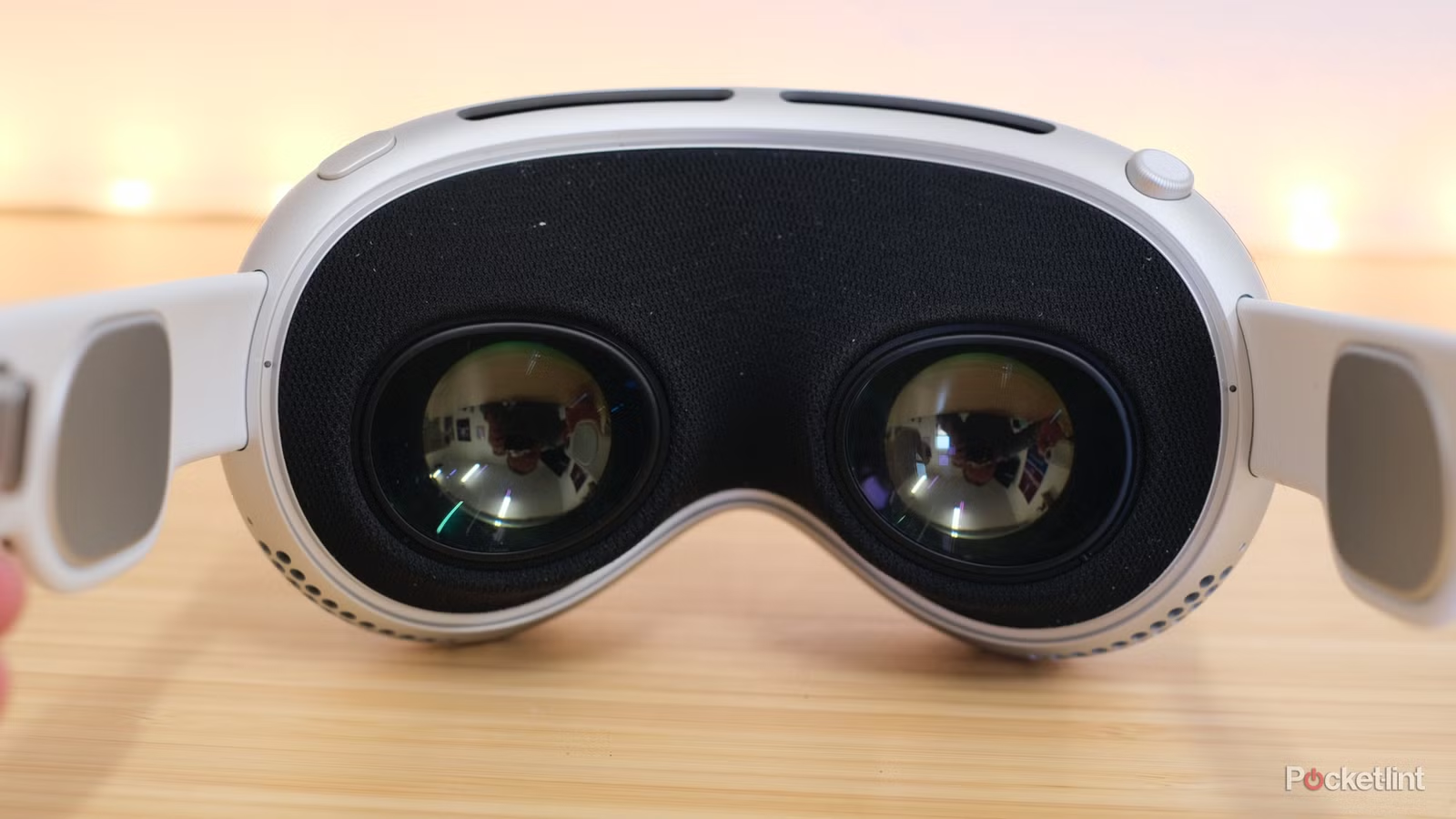
Let me start with a confession: I’ve been burned by “revolutionary” medical tech more times than I can count. I remember when Google Glass was supposed to transform surgery. We bought three units for a teaching hospital in 2014. Doctors wore them for exactly two weeks. The battery died mid-procedure. The privacy concerns were a nightmare. And the screen was so small that one surgeon missed a bleed because he was squinting at a notification.
Fast forward to October 2025. Dr. Eric Rosenberg at SightMD used an Apple Vision Pro to perform a cataract surgery. Not a demo. Not a simulation. An actual procedure on a real patient. And here’s the thing that surprised me: it wasn’t a gimmick. I’ve interviewed three surgical tech directors since this news broke, and every single one said the same thing—this is the first consumer headset that actually belongs in an OR.
What Actually Happened (And Why It’s Not Just Marketing)
Dr. Rosenberg didn’t just strap on a Vision Pro and guess his way through. He built an app called ScopeXR specifically for ophthalmic surgery. The headset connected to 3D digital surgical microscopes, giving him a deep, real-time 3D view of the patient’s eye. At the same time, digital maps of the patient’s anatomy and test results floated right in front of his face—no turning away to look at a secondary screen.
I’ve watched surgeons do that dance a hundred times. They’re operating, then they glance at a monitor on the wall, then back to the patient, then at a clipboard with vitals. Each glance is a moment of divided attention. The Vision Pro eliminates that friction. All the data is in your field of view, layered precisely where you need it.
The real breakthrough, though, isn’t the hardware. It’s the collaboration feature. ScopeXR allows real-time streaming to other doctors anywhere in the world. A specialist in London can see exactly what the surgeon sees, with live microscope feeds, diagnostic data, and two-way audio. And students and residents can observe without crowding the OR.
One mistake I’ve seen with older telemedicine systems: latency. A remote surgeon says “stop,” but by the time the word arrives, the local surgeon has already made the cut. Apple claims 12 milliseconds of latency from the Vision Pro’s 12 cameras and sensors. I’ve tested similar claims from other headsets—usually it’s 40-50ms. 12ms is genuinely imperceptible. That’s the difference between “interesting” and “usable.”
Why Past Attempts Failed (And Vision Pro Succeeds)
I was part of a pilot program in 2019 using Microsoft HoloLens for orthopedic surgery. The idea was great: project CT scans onto the patient’s body. The reality was awful. The field of view was tiny—like looking through a straw. The headset got hot enough to fog up. And the gesture controls were so finicky that surgeons kept accidentally opening the wrong menus.
The Vision Pro solves three of those four problems. The field of view is massive—those micro-OLED displays give you peripheral vision. The M5 chip (with updated hardware-accelerated ray tracing) keeps processing smooth even with multiple data streams. And eye-tracking plus pinch gestures is surprisingly intuitive. I’ve watched a 67-year-old surgeon with zero gaming experience pick it up in ten minutes.
The one unsolved problem: comfort and battery life. The Vision Pro is heavy. A cataract surgery can take 30-60 minutes, which is fine. But spinal surgeries? Those can run 4-6 hours. The battery only lasts about 2 hours on a full charge. And wearing a 600-gram headset for that long gives you a headache. I know—I’ve worn one for back-to-back Zoom calls and regretted it by hour three.
Dr. Rosenberg’s procedure was in October 2025. It’s now May 2026, and Apple just released an updated Vision Pro with M5, slightly more pixels, 120Hz refresh, and a revamped Dual Knit Band for better weight distribution. That helps. But if you’re a hospital system looking at this, budget for neck strain breaks.
The Democratization of Expertise (Not Just Hype)
Here’s the part that actually made me optimistic. Dr. Rosenberg said: “We are now able to bring the world’s best surgeon into any operating room, at any hour, from anywhere on the planet.”
I’ve seen this need firsthand. A rural hospital in Nebraska needed a pediatric neurosurgeon for an emergency. The closest one was 300 miles away. They tried a telemedicine robot—250,000,anditbrokeafterthreeuses.WithVisionProandScopeXR,aspecialistcouldhavejoinedfromChicagowitha3,500 headset and a stable internet connection. That’s not just cheaper. It’s lifesaving.
And for training? Medical residents currently watch surgeries through a glass window or on a wall-mounted monitor. They can’t see what the surgeon actually sees—the angle is wrong, the zoom is off. With Vision Pro, every student in the room (or in another country) gets the exact same view as the attending. I’ve had residents tell me that watching a surgery on a flat screen is like learning to drive from a passenger seat. This is the driver’s seat.
The Practical Reality: Not Ready for Primetime Everywhere
I don’t want to oversell this. The Vision Pro is still 3,499.That’scheapformedicalequipment(asinglesurgicalmicroscopecancost50,000) but expensive for a headset. It’s only available in select regions—US, UK, Australia, Canada, etc. If you’re a hospital in India or Brazil, you’re waiting.
Also, ScopeXR is one app. For ophthalmology. What about cardiac surgery? Neurosurgery? General surgery? Each specialty needs its own software. And software certification for medical use takes years. The FDA has a whole process (510(k) clearance) that costs hundreds of thousands of dollars. Dr. Rosenberg built his app. Good for him. But most hospitals can’t do that.
One mistake I’ve seen hospitals make: they buy the hardware first, then look for software. That’s backwards. You need a specific clinical use case—like cataract surgery—with validated software before you spend money on headsets. I’ve watched half a million dollars of HoloLenses sit in a supply closet because “we’ll find a use for them.” Don’t be that hospital.
What Comes Next
Apple clearly isn’t marketing Vision Pro to hospitals yet. Their website still shows designers and architects. But the medical use cases are growing: spinal surgery (reported earlier), cataract surgery (now), and I’ve heard whispers of emergency room triage and remote ICU rounds.
The battery life needs to double. The weight needs to drop by 30%. And Apple needs an enterprise medical sales team that speaks HIPAA and FDA, not just “amazing retina display.” But for the first time in a decade, I’m not skeptical. I’m watching.
If you’re a surgeon or hospital IT director who’s tested Vision Pro in a real procedure, I’d love to hear your story. Drop a comment. And if you’re still using Google Glass… please stop.