11 Popular Apps That Track Your Data – And How to Stop Them
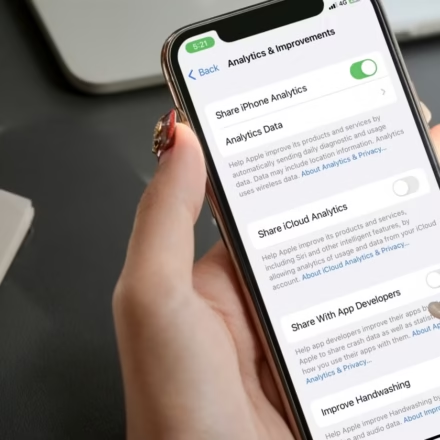
Smartphones have become an essential part of daily life, packed with apps that let you do far more than just call and text. From social media to shopping and streaming, these tools keep us entertained and connected. But this convenience comes at a cost: many apps track your activity extensively. Companies collect data for personalized advertising, sharing with third parties, user analytics, product customization, and app optimization. With privacy concerns at an all‑time high, it pays to know which apps are tracking you and how to limit them.
Below are 11 widely used apps, their tracking practices, and actionable steps to protect your data.
1. Facebook
The Cambridge Analytica scandal exposed Facebook’s privacy failures, affecting 87 million users and leading to a $5 billion FTC fine. A 2021 breach leaked data of 533 million users.
What to do:
Go to Settings & privacy → Accounts Center → Your information and permissions → Your activity off Meta technologies. Disconnect past and future activity from third‑party apps, and clear previous activity.
2. Instagram
As a Meta product, Instagram tracks location, browsing habits, and more for targeted ads.
What to do:
Same as Facebook: disconnect third‑party activity under “Your activity off Meta technologies.” Export your data via Accounts Center → Your information and permissions → Export your information to see exactly what’s collected.
3. LinkedIn
LinkedIn faced “BrowserGate” – tracking over 6,000 Chrome extensions to collect digital fingerprints, without disclosure in its privacy policy. In 2012, its iOS app was found reading calendar entries including passwords.
What to do:
Tap your profile picture → Settings → Advertising data. Disable all three sections: Profile data, Activity and inferred data, and Off Linked data.
4. Amazon
Amazon tracks location, spending habits, shopping data, voice recordings, and contacts across its ecosystem.
What to do:
Go to Your account and turn off personalized recommendations. Then App Settings → Permissions to deny access to Bluetooth, camera, contacts, location, microphone, SMS, and phone data. Consider using privacy browsers like Brave or DuckDuckGo for shopping.
5. YouTube
Owned by Google, YouTube uses your watch and search history for personalized ads and recommendations, and shares data with third parties.
What to do:
Open Settings → Your data in YouTube (redirects to Google’s privacy dashboard). Download your data, and disable watch/search history (including voice) to prevent personalization.
6. X (formerly Twitter)
Under Elon Musk, X collects data for targeted ads and third‑party sharing. It also trains its AI (Grok) on user data.
What to do:
Tap profile → Settings and privacy. Under Your account → download data archive. In Security and account access, revoke permissions for connected apps. Go to Privacy and safety → Data sharing and personalization to disable personalized ads, prevent activity tracking, restrict third‑party sharing, protect location data, and stop Grok training.
7. Uber
Uber once tracked users for five minutes after a ride ended. It uses data for personalized ads and analytics, though it claims not to share with third parties.
What to do:
Go to Account → Settings → Privacy. Disable personalized ads and marketing offers. Adjust location tracking – limited because location is necessary for the service.
8. Google
Google collects vast amounts of data across search, Play Store, YouTube, and more for personalization and ads.
What to do:
Tap profile → Search personalization → disable. Turn off personalized ads under My Ad Center. Then Manage your Google account → Data and privacy. Disable Web & App Activity, Google Play History, YouTube History, Timeline, and personalized Play recommendations. Also review Third‑party apps and services and remove unnecessary connections.
9. Spotify
Spotify tried to patent a mood‑sensing speech recognition tool (still active) and was fined €5.4 million by the EU for GDPR violations related to data transparency.
What to do:
Tap profile → Settings and privacy → Privacy and social → scroll to the “Account Privacy” link. Disable tailored ads. Request download of your account data (5 days) and streaming history (up to 30 days).
10. Snapchat
Snapchat uses your snaps and content to train AI, shows tailored ads, and tracks location via Snap Map.
What to do:
Enable Ghost Mode in settings. Go to Profile → Settings (gear icon) → Permissions → disable location and other unwanted permissions. Under Privacy controls, use My Data to download collected information. In Generative AI Settings, prevent your snaps from training AI, and delete existing AI data.
11. TikTok
TikTok’s Chinese parent company ByteDance has raised privacy concerns. The U.S. operations now run under a separate structure, but data tracking remains aggressive.
What to do:
Go to privacy settings and clear your data. Avoid providing unnecessary personal information. Use a trusted paid VPN while using TikTok for an extra layer of protection.
Summary
Many popular apps track your location, browsing habits, contacts, and even voice data. While you can rarely eliminate tracking entirely, you can significantly reduce it by adjusting in‑app privacy settings, disconnecting third‑party services, downloading your data for transparency, and using privacy‑focused tools. Awareness and proactive management are your best defenses.